Last season, Ventura College men’s basketball didn’t have the record it wanted. The pieces were there, but something was missing. Fast forward to this year, and the Pirates are league champions and a serious playoff contender. So what changed?
According to assistant coach Kane Daniels, it started with one thing: culture.
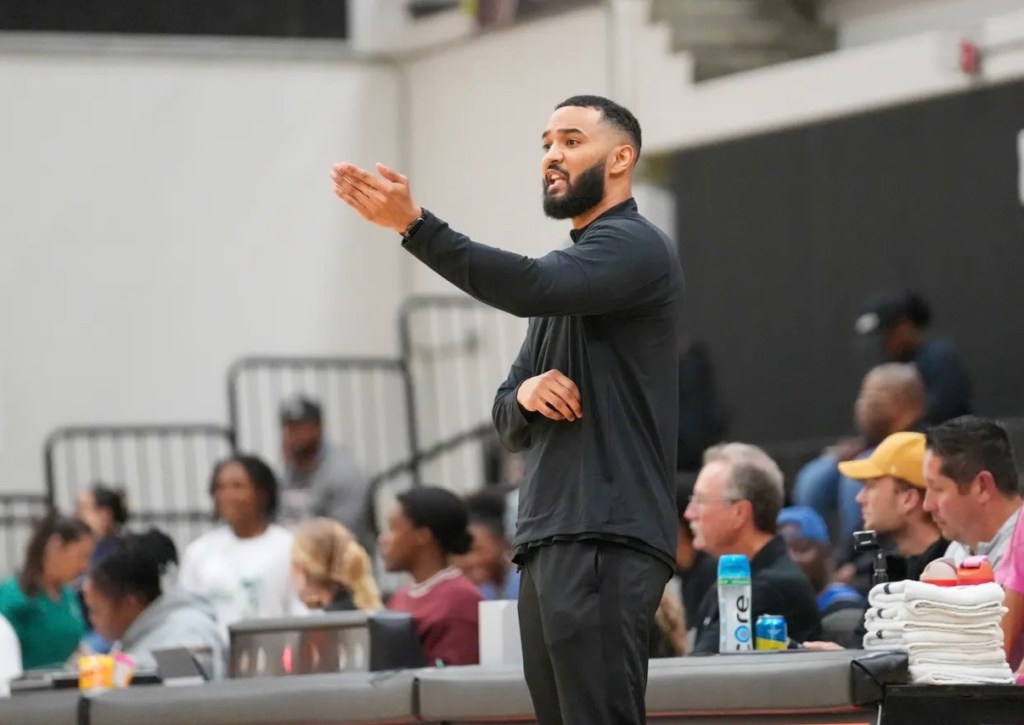
Photo from VC Star
“The focus was the culture,” he said. “Conditioning is something they took pride in.”
Practices were intense. Players were pushed to embrace hard work and stop avoiding uncomfortable situations.
At the start of the season there was an adjustment period with a new system, and it took some time for everyone to get comfortable with it. But little by little, the players bought in and started to fully embrace the change.
Now, he describes them as mentally tougher and ready for challenges. The goal became clear. Coach Kane said, “Get comfortable being uncomfortable.”
That mindset showed up in their playoff opener.
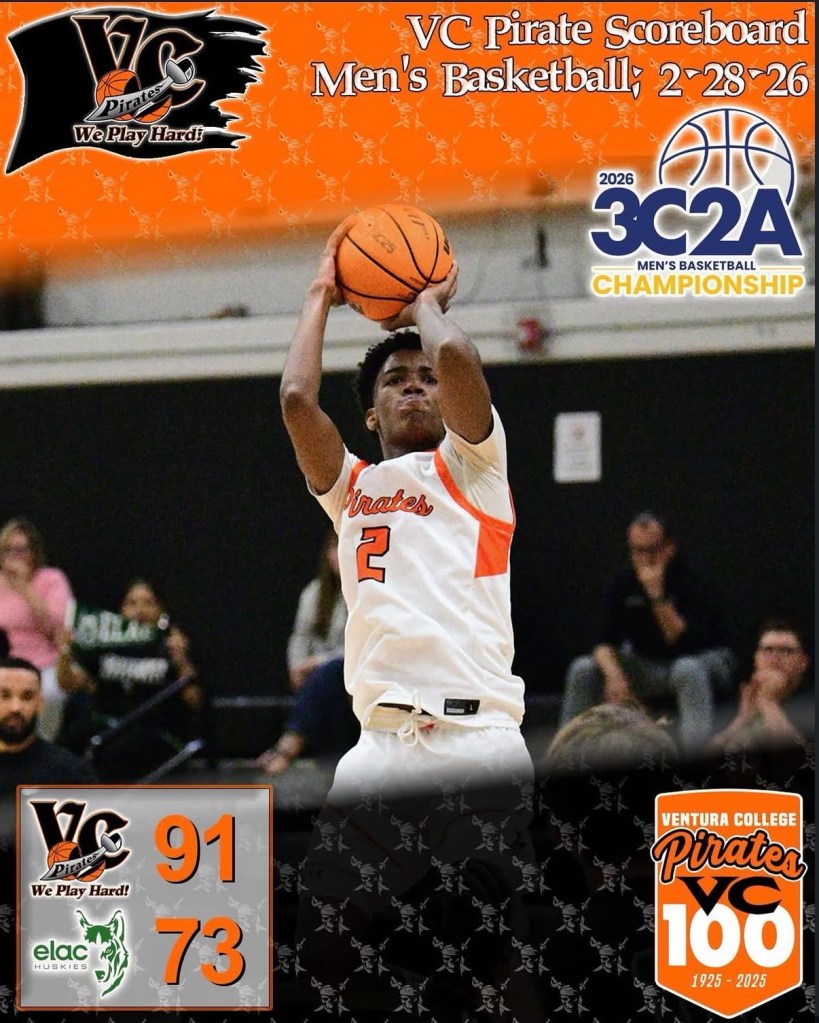
In the second round of the 3C2A Southern California Regional Playoffs, the Pirates were in a close game at halftime against East Los Angeles. But in the second half, everything clicked. VC dominated the final 20 minutes, pulling away for a 91–73 win at home. Sophomore Kam’Ron Cigar led the way with 33 points, and the team outscored the Huskies 53–35 after the break. It wasn’t just talent it was discipline and energy.
Photo from @vcpirateathletics
The turnaround didn’t happen overnight. According to Coach Kane, it came down to daily habits: staying focused, keeping a positive mindset, learning from each other, and embracing hard work every single day.
What this season taught the team was simple but powerful: stay consistent and stay mentally tough.
From a season that didn’t meet expectations to a league championship and playoff run, VC men’s basketball proved that changing the culture can change everything. And if their first playoff game is any sign, they’re not done yet.
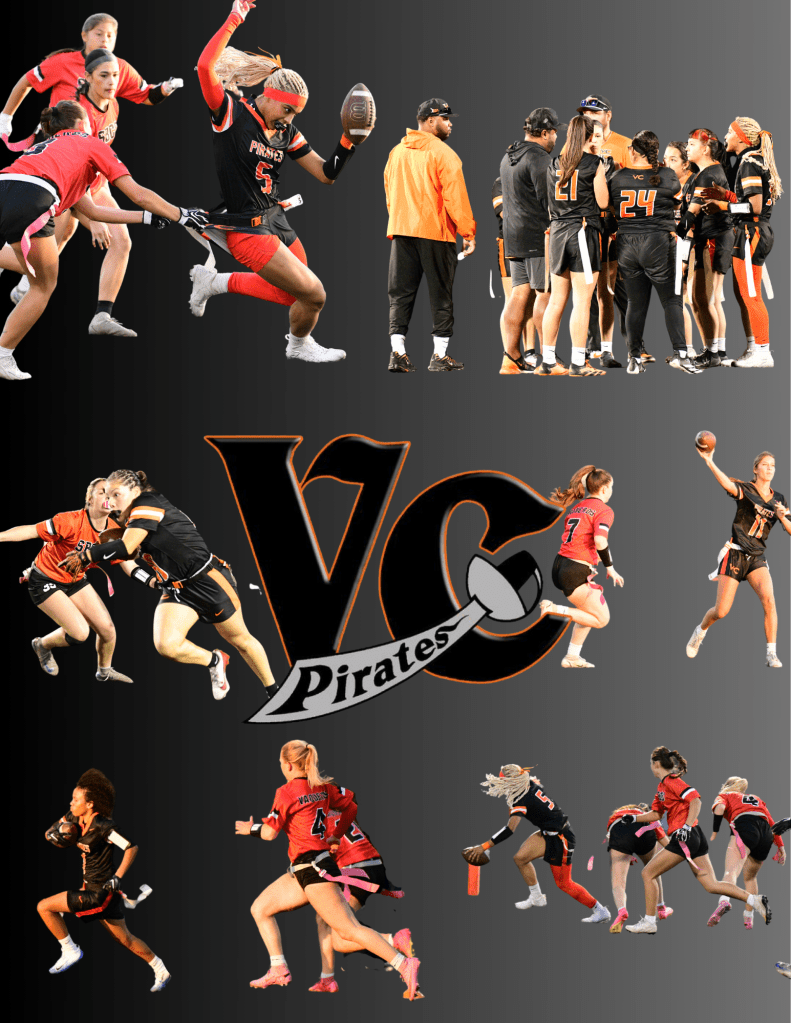
With quarterback standout April Luna having 5 passing touchdowns in their 45-6 win on the road, Ventura College’s new flag football team is on a 3-game winning streak with a 5-2 overall record. Ventura College’s flag football team is making history by adding a new women’s sport to their athletic program, bringing their total to 20 sports. Ventura is now one of 9 community colleges in California to have a flag football program. This flag football program gives female athletes more opportunities to play at the collegiate level and offers scholarship opportunities.
Women’s flag football has been around for more than 60 years, but it wasn’t until recently that they formed the WFA (Women’s Flag Football Alliance). With women’s flag teams growing, they partner with organizations like the NFL and Nike to help raise money and awareness for this 40-team organization.
The NCAA now has 40+ schools sponsoring varsity teams, with the NAIA allowing programs up to 12 scholarships per team. This allows more opportunities for female athletes to earn their degree with a scholarship while playing a sport they love. VC’s flag football program does the same. This widens opportunities for female athletes to continue playing at a four-year university while also getting their bachelor’s degree.
Now the question is: how do female flag football players get noticed at a DI level? The answer is visibility! Visibility is important because you can be the best person on the team, but if nobody is noticing you or talking about you, scouts cannot find you. Although flag football is growing, colleges like VC are struggling with visibility. I created a survey for VC students about the new flag football team. With 34 responses, 73.5% of people did not know that VC had a flag football team, but 70.6% of people would attend a game if they knew about it. When asked what they think about VC adding this new sport, one student states, “It’s very nice to see more variety in the sports at VC,” and another student says, “I think it’s cool; just make it more known because I haven’t heard of it.” This survey shows the importance of visibility. People are interested in going and supporting the team, but they did not know that we had this sport. To increase visibility, VC could promote the games more, hang up flyers for games, post it more on social media, and add activities to get the students involved at halftime during the games.
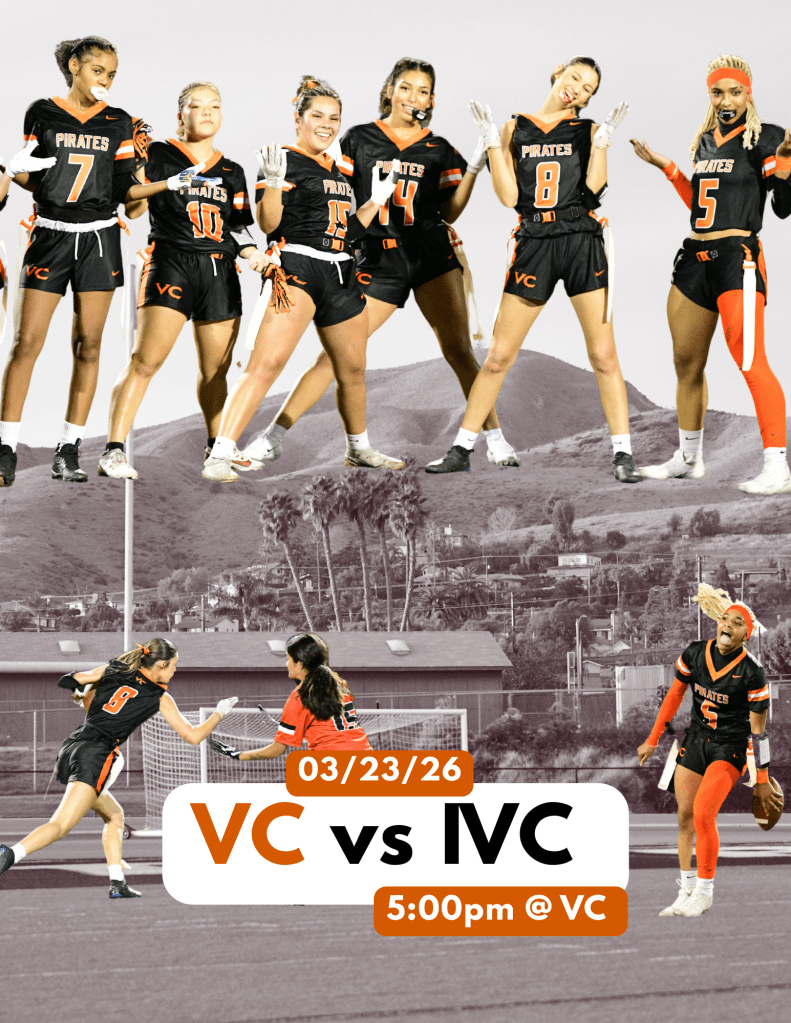
This program has all the potential to succeed in the future with the team currently having a breakout season blowing out the competition. With the future of flag football growing VC is breaking the stereotypes of female sports, making a more inclusive campus. When asked what kind of effect do you think this program will have not only for female athletes but also the female student body? One student answered, “I think this creates a lot of opportunities for female athletes. For the longest time it was seen as a “boys” sport, so this will shift culture. It will challenge stereotypes and normalize strength, aggression, and athleticism in the female body” whereas another student answered, “I think it is a great gesture and unfortunately will underperform expectations on a broader scale. Female flag football just doesn’t have the same effect on the campus as mens college football does.” This is the stereotype this campus is trying to solve. Women’s sports can be just as entertaining as men’s sports if people take the time to watch it. Like the student pointed out, this creates more opportunities for female athletes whether that be for health reasons or for scholarships reasons. This program strengthens the inclusivity on campus and promotes new opportunities for women and the female student population. The best way this program can succeed is to build visibility. The season ends early May so there are many more games! Come and support your fellow students and who knows you might fall in love with the sport yourself. Come and find out March 23 when VC plays Irvine Valley college at VC at 5pm! This is just the beginning of a great season!!
Balancing an academic schedule with being a track athlete is no small job. This is Caleb Stremcha, a junior college student who is also a mechanical engineering major and a track athlete. Every day he is careful and dedicated. When asked to describe a typical day, he said, “A typical day for me is very structured because I balance school, work, and track throughout the week. I attend classes four days a week and am currently taking 28 credits as a mechanical engineering major, so my time management is essential.”
Track practice is central to his routine. “Fortunately, three of my classes are online, and another one of my classes is track & field, which allows me to dedicate more of my time to my STEM courses,” he said. “On Mondays and Wednesdays, after finishing classes, I have a few hours of break for lunch and then head to track practice. On Tuesdays, Thursdays, and Fridays, I work for six hours before school, so on those days, I spend time recovering at home.” His days run from 8am to 6pm, so planning is a struggle. “I try to stay organized and plan ahead to keep everything on track.” Time management is his biggest challenge. “The biggest challenge is definitely managing time and maintaining energy throughout the day,” he admitted.
With mechanical engineering courses, he faces frequent overlap of assignments and exams. “At the same time, I still want to maintain a strong commitment to my training and internship.” And because his classes don’t always align with practice, he has to stay motivated. “Staying organized and using the flexibility of my online classes has been key.” The mental toll can also be heavy. “Balancing both roles can be mentally taxing at times,” he shared. “Having most of my day filled with classes, work, and training can feel overwhelming.”
Yet he leans on his support network. “I have friends in several of my classes, which helps the academic side feel more manageable,” he said. “And my girlfriend is very supportive and flexible with her schedule, so we can still spend time together.” These connections keep him grounded even in the busiest weeks. Support systems are crucial for his balance. “I have been fortunate to have strong support from several areas of my life,” he noted. “My professors are understanding of the commitments that come with being a student-athlete, and they’re often accommodating.”
His coaches also understand his dual dedication. “My coaches recognize the academic demands and support my efforts.” Even his work environment plays a huge role, “My workplace and internship have been very flexible with my schedule, which has made a huge difference.” Knowing people have his back helps reduce stress. “Having people who understand the balance I’m trying to maintain has helped reduce a lot of stress.”
Recovery of both mental and physical is a priority. “Recovery is something I’ve learned to take seriously because my schedule is so packed,” he said. “Physically, I manage my training load carefully, especially since some of my workouts are done independently.” Track practice spread throughout the week also helps him avoid burnout. “Mentally, I use my evenings to reset whether that’s resting, sleeping or self care”. Overall this shows how a junior college athlete lives and the amount of time he dedicates to both athletics and academics.
Come along as I spend 10 days in New York City, from going to sporting events to exploring New York’s iconic parks all while having a great time! Video Out Now, On VC Social YouTube Channel!
Nestled in the Ojai Valley, Soule Park Golf Course designed in 1962 by William F. Bell was renovated in 2005 by famous golf course architect Gil Hanse. This transformation led to Soule Park becoming one of the best public golf courses in California because of its beautiful scenic views surrounded by the Topatopa Mountains, high quality maintenance all with affordable green fees.
Covering over 300 acres of land, this 18 hole, 6,800 yard, par 72 course is a perfect spot for golfers to enjoy a peaceful and scenic round of golf in the heart of Ojai Valley.
Best Private Golf Course
The Saticoy Club
Tucked in the hillsides of Somis, The Saticoy Club is the first private members only club in Ventura County. Designed in 1921 by architect William F. Bell, The Saticoy Country Club is regarded as “one of the most respected and elite golf courses in Southern California”.
It has hosted many USGA Championship Qualifiers and Amateur Championships. This 18 hole, par 72 championship golf course is known for its pristine conditions and challenging layout, making it one of the best private courses in Southern California.
Best Overall Golf Course
Sherwood Country Club
The Sherwood Country Club, a Jack Nicklaus designed signature golf course in Lake Sherwood in the Santa Monica Mountains. This PGA Tour course is no secret to fame, Tiger Woods has won 5 times on this course during the “World Challenge” Tournaments.
Tiger Woods Playing at Sherwood Country Club
Opened in 1989, Sherwood Country Club has around 375 golf memberships, this members only golf course is the best golf course in Ventura County with its perfect conditions, beautiful scenery surrounded by luxury homes, and has a great history from PGA events.
Best Affordable Golf Course
Camarillo Springs Golf Course
If you want affordability, peace and quiet, Camarillo Springs is your go to. This scenic course pays for itself just from the breathtaking views of the mountains and peacefulness. If you want to have a nice round of golf with your friends, drink some beers and have a good time then you will definitely enjoy playing this course. Though it is not maintained too well, you have to try out this course if you want some peace and quiet. Located right off the 101 in Camarillo, this 18 hole, par 72 course is a great bang for your buck.
Hidden Gem
Sterling Hills Golf Club
Sterling Hills, a hidden gem in Ventura County. This 18 hole, 6,800 yard, 71 par course was designed in 1999 by Damian Pascuzzo and Robert M. Graves. In between the Camarillo hills and avocado trees lies Sterling Hills golf course, the first and only public golf course in Ventura County when it opened in 1999. Surrounded by tall Eucalyptus trees, this course is in great condition, has a lot of elevation changes, and has a feel of a private golf course. If you want a peaceful round of golf surrounded by great landscapes, Sterling Hills is the place for you.
Learning is especially difficult for someone with ADD like myself. Sitting still is even more so of a challenge. So when I want to take a break and relax with a hobby, what do I do? I decide to learn different types of crafts to satiate my need to work with my hands. It’s a double edged sword: learning a new skill, controlling the need to move my fingers, and keeping my procrastination and perfectionism managed. So here is a breakdown of my favorite crafts and how I (barely) manage to execute them.
Crochet
Knitting works as well but since I’ve never been good with two sharp sticks, I have decided to stick with one dull hook. For those of you who don’t know the intricacies of crochet versus knitting, I don’t really either but that’s the main difference. This craft is great for turning your brain of and just following a pattern. But that only works for me if the pattern is simple. As it turns out, those craft influencers who can zen out while making a complex, intricate sweater or stuffed animal are way out of my skill level. Who knew that not everything on the internet is as easy as it seems? Still, if you’re comfortable with making less than visually impressive pieces, crochet is a great way to pass the time. I highly recommend it as a sort of fidget toy while watching TV; doing something with my hands really helps settle my mind and hands for a good show binge or movie night and there’s no fear in stabbing your hand on anything sharp while you watch!
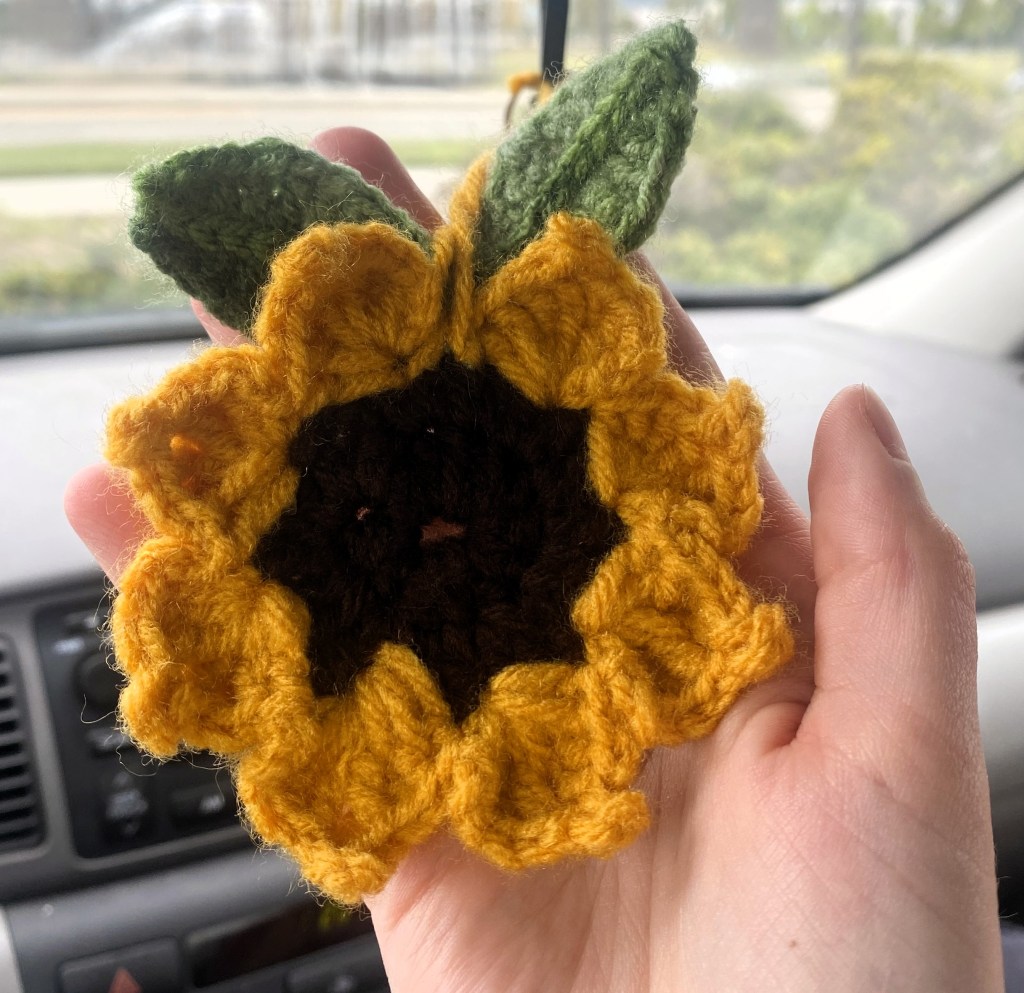
For those of you especially obsessed with the cutesy, eye catching TikTok patterns I’m afraid I’ll have to disappoint. My latest crochet piece is simply a blanket with chunky yarn. No fancy stitches or patterns, just row after row of a half double crochet in the back loop (sounds complex but it’s really simple, I promise). If I ever get around to finishing it, it’ll be the perfect couch blanket for when you have guests over and want to talk about your crochet hobby. But since a picture of a simple half finished blanket isn’t very interesting, I have other visual offerings: crochet flowers, one of which uses embroidery floss and a very long stem to create a bookmark, while the other is just a rearview mirror accessory.
The aforementioned mirror accessory, a crocheted sunflower.
Sewing
Honestly, everyone should know how to sew. Sure, crochet, knitting, and other yarn crafts can be practical as well but be honest, when are you going to wear that itty bitty crochet tank top that you saved the pattern for after seeing it on TikTok? And don’t even get me started on itchy yarn. After I finally started my own sewing journey after years of dreaming of it, I can attest that it is the definition of “easy to learn, hard to master.” But again, this is coming from my clumsy hands and ADD brain. Anyway, I digress. Sewing is perfect for those who want to be productive while procrastinating. Have to do chores? Sew an apron instead! Homework needs to be done? Why not sew yourself a new bag to put all those unfinished assignments in! It’s as handy as it is consuming. There is no zoning out during sewing, only locking in. Otherwise, you may end up with a finger sewn into that hem you’re working on. (I haven’t ever seen it happen, but I heard stories. Terrible stories.) If your ideal hobbies involve repetition, tidiness, and a rather intense focus, then sewing is most certainly your best bet at keeping your hands (and mind) busy for a few hours, days, weeks, or months (depending on the project).
Sadly, I haven’t been able to finish any sewing projects outside of a costuming class I took a few semesters ago. I’m in the middle of making a “bento box bag,” as the pattern calls it, though right now, it’s just a bunch of squares sewn together. But to show you what I’m capable of when there’s a deadline (and for some much needed visual appeal), here are the costuming class projects that got me started with sewing: a hat and corset.
My homemade hat and corset actually go rather well together.
Embroidery
Do you like drawing but hate how easy it is to just draw a line? Well, now you can use thread, needles, and at least 10 different stiches to “draw” that straight line instead! Jokes aside, I really can see why women did this so much back in the day (although I’m sure it was more handy back then). Embroidery is takes all the precision of sewing and the creativity of drawing to make a tactile experience that feels like you’re a Regency era lady waiting to be called upon by a gentleman suitor (or maybe I’ve watched too much Bridgerton). Ignoring my embroidery fantasies, it is really lovely to do when sitting and listening to something—no TV since your eyes shouldn’t really stray from the pointy needle. I did hear somewhere that audiobooks are a great listening option. But aside from the aesthetic nature of the process, you can really get creative with your canvases. While it may not hold up great over time (especially for beginners with maybe some looser stitches), I’ve seen many cute embroidery projects on jeans, shirts, jackets, and even shoes (Converse, of course). Even simple stitches can turn into beautiful patterns and arrangements with the right technique and design. Plus it is so fun feeling a thread-dense pattern after it’s complete. The texture is simply top notch (is that a thread pun? I didn’t intend it but if it works then I definitely did intend it).
My latest embroidery project is a throw back to the type of embroidery that first got a needle in my hand: phrases with flowers. I don’t know why, but I always liked the idea of embroidery that goes in a bathroom or hallway, ones you’d see in your Grandma’s house with cheesy phrases surrounded by cutesy little flowers. Except, well… I put my own spin on it as you won’t be able to see due to some mature language. Use your imagination as to the combination of some select swear words and “live, laugh, love”-esque mantras. Sometimes, you just want to make something that makes you giggle and that’s enough of a reason to create it. The piece I am most proud of however, is a thread-painted water lily. Yes, I did simply color the water with markers and yes, it was to create dimension on the fabric. And I was lazy. At least I finished this one, ok?
The water does actually kind of look good though…
Miniatures
I only just recently started to explore the world of miniatures but boy are they fun. Frustrating at times, but fun! I’ve always loved dioramas and little scenes and objects so it was only a matter of time before I ended up buying my own miniature kit. I’ll admit, I was influenced by those little bookend dioramas you can see ads for on TikTok and Instagram. But since those were far bigger (ironically) and more intricate than I was ready to handle, I settled for a less involved set. And it was especially useful for the part of my brain that hyper-focuses on one thing for hours (as fleeting as that part can be). I have literally spent hours in what felt like a blink of an eye crafting a tiny little table with a tiny little photo frame next to a tiny little flower pot. But I’ve found that at times even my tiny little hands are too big for some of the miniatures (and I do have proof that my hands are about the size of a 12 year old’s). The end result is very satisfying but miniatures are not for the weak willed. There will be times when you just want to throw it against a wall and smash it because you just can’t get the angle of the pieces just right. Not to mention the back pain that comes with hunching over all the tiny little pieces. Like sewing, you really need to be locked in for this craft to work for you and as frustrating as sewing can be, it’s easy to start over with a seam ripper. As for miniatures, it’s impossible to move something once the glue dries. Precision and perfection are how I’d ideally describe miniatures; although I’ve been not very successful at either, it is still fun to create your own little world (but if you got the cash to spend, I’d recommend Lego for that set creation satisfaction).
As a warning, here is my first and only miniature I’ve ever done, unfinished (as nearly all my projects are). The directions were sometimes confusing but at least it’s possible to customize your miniature using the materials given. I’d suggest finding a niche within the miniature community, since it’s far more satisfying to work on a garden scene when you like flowers. Your end goal is usually a display piece so find a kit that you’re going to love putting the work into.
The current progress on my miniature garden shed.
Paper Crafts
Ok, I’ll be honest. I haven’t really done much paper crafts. I’m painfully terrible at origami (literally, paper cuts hurt) and as for papier mâché, I can only handle so much glue on my hands before my brain goes into an overstimulated shutdown. My solution was crepe paper flowers. I don’t know if you can tell by now but I really like making flower-based things, so my choice of paper crafts shouldn’t come as too much of a shock. But that is kind of the point: regardless of what kind of craft you pick, you have to make things that appeal to you. I made a bunch of crepe paper flowers years ago to give out during Valentine’s Day to classmates, random people, just trying to brighten someone’s day. And you know what? I did not give out much, but the point wasn’t about giving them all away as much as it was doing something kind for others. Paper crafts are down-to-earth, simple projects that you could even do with young children. The process of it has been my favorite so far. Nothing has made me connect with my inner child more like those crepe paper flowers. I felt like a little second grader again, playing with paper and tape, making gifts for strangers for the fun of it. Not to mention, there is something beautiful about its fleeting nature. This craft is wholesome but insanely impractical and delicate. You have to appreciate what it is and then completely let it go; it’ll most likely end up smushed or crumpled beyond recognition in a few hours. And that is something I enjoy with my creative endeavors. Something to keep my fingers moving but also something that I can be ok with, even with all its imperfections. And to be honest, that’s what crafting is, right? If you never let go of any project, then you’d just be stuck on one, trying to perfect it over and over again. Be at peace with the crooked stitches, wonky seams, smudged paper. Be proud that you made something and then do it again. Now, if I could only finish my projects before I move on to another one…
BookTok is just women who are functionally illiterate.
BookTok [pisses me off] so bad, it’s all like all dumb [people] gathered at the same place.
All I’m really saying is that all of the women on “BookTok” need to be banned from continuing to “read.”
Whether you agree with these comments or not, there is a conversation in them that must be had.
I want to begin this conversation by addressing that I will be using only male and female genders, along with stereotypical gendered behaviors, to discuss a broader societal concern. However, that does not wholly remove other genders from this conversation. Furthermore, this is not a hate piece about men. It’s more so a call to action; a hope that they aren’t left behind.
Are you familiar with “male flight?” It’s possible that you don’t know the phrase, but you’ve watched it happen. Simply put, male flight refers to the phenomenon where, as an activity, occupation, or product is increasingly associated with women, men leave. It is often coupled with the fear of being seen as unmasculine and is likely an unconscious action. During male flight not all men leave, of course, but it is a big enough shift for it to be named.
Now that you’re familiar with the term, what does all of this have to do with BookTok hate comments? I am so glad you asked! I would love to give you a short and sweet history lesson.
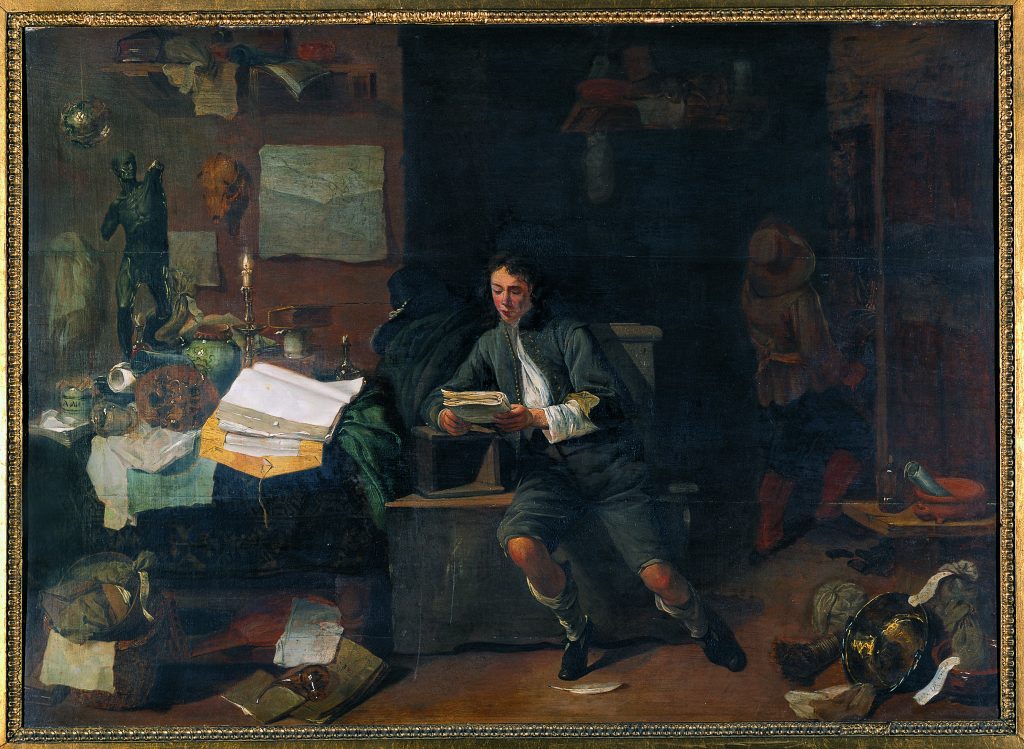
Young Man Reading byJacob van Loo
In the days of Christian Europe, reading and accessing books was not for just anyone; it was for wealthy men. It wasn’t until modern times that learning to read and having access to books became more widely available. Still, women’s reading habits were monitored and restricted. It wasn’t until “the turn of the twentieth century, women’s access to higher learning and the appearance of mass culture, for mentalities to evolve. Today, the relation to books has been completely reversed, as the world of books is generally considered as feminine” (Matamoros).
Now, in the United States, at least, women are free to consume the content they wish to. With the rise of social media, women can connect with other women, form communities, and share ideas. It all feels positive until you remember the comments from the beginning.
The more women find interest in reading, the more it is seen as a feminine hobby rather than a masculine one. Thus, the more you will see male flight. There are many issues with males refusing to read; one being that they are missing out on vital information that can help them understand the world, their peers, their partners, their families, and themselves. Studies already show that men struggle to consume content from perspectives unlike their own. Women’s Prize released an article sharing, “research confirms that while women read books by women and men equally, men overwhelmingly reject books written by women in favour of male authors.” Men are actively leaving a space that is vital to their growth.
The fear of male flight is not unwarranted. When men flee a space, its value is lessened. Though I wish that were not the case, the more women are centered in the writing world, the more literature, books, and the career of writing will be devalued. This could lead to less funding, less pay, less attention, and even less education. Men fleeing the hobby of reading is damaging enough, but then those actively hating on women who enjoy reading makes male flight truly harmful to everyone involved.
The discourse and hate around women’s reading habits, especially online, seem to form around romance novels. While many women enjoy romance novels, it’s not the only genre they engage with. And, despite what many may think, fiction and non-fiction hold equal importance. Though fiction can be more flowery and feel frivolous or shallow, it often takes important concepts and makes them more digestible and entertaining. One can learn just as much from a self-help book as one can from a hero’s journey fiction novel. The assumption that romance has no value should be concerning to all. And while there is a very real conversation to be had about the types of romance that exist and the age levels that people are consuming those novels, it doesn’t then mean all romance is bad and trivial.
Penguin Random House Booker Prize-Winning Books
As a woman in the book industry, I fear what will happen to literacy rates and the world of reading if men deem it worthless. I started my career in books at Ventura College, learning the foundations of literature with Professor John Guelcher. I sat down with him to discuss this issue of male flight, asking him his thoughts and solutions to this very real issue.
I opened the conversation by asking if he had seen a shift in the number of men versus the number of women in his classes. He noted that his classes have always leaned female, now with rates as high as 75-80% female. When I asked why he believes that to be the case, he brought up that in the past thirty years, the way higher education is structured has shifted to a more stereotypically feminine way of teaching. There is less of a focus on competition and more of a focus on group work and connection. Without the competition as a motivator, Guelcher thinks men are struggling.
Guelcher: Males have a harder time succeeding in the academic institution as they are constructed now. I think that’s what’s happening in the classroom.
Guelcher then continued to bring up other influences on male flight.
Guelcher: As it pertains to the specific discipline of English, I think that you also have this privileging of STEM. It’s this default thing you should do. If I ask my students what their major is, no one ever says the Humanities. They say, “Oh, Business.” “Why are you a business major?” “I just wanna make money.”
This comment sparked my interest because all I have seen in recent years is a push for more women in STEM. Even with the encouragement, though, “America needs still more diversity in STEM fields…Currently, women represent just 10% to 25% of the semiconductor industry, and historically underrepresented groups make up only 20%” (Women in STEM). So, while women are entering STEM, it is still seen as a worthwhile pursuit for men, and the humanities are falling to the wayside. I don’t say this to devalue or discourage STEM involvement, I merely say it to say that both are valuable and necessary, and we can’t leave either behind because women want to be a part.
Whittington: Unfortunately, if men are not actively engaging in literature and aren’t interested in it, it will not be seen as a worthy pursuit or usage of time. Which then eventually shifts to women who are authors being paid less because it’s not as important. When it is a male-dominated field, then it is important, and it is worth paying a lot of money for. And as we see this shift to it being very female-centered, there is a worry about how female authors are going to survive. There is that kind of slight fear of, “what happens to us?”
Guelcher: I think there are two levels. There’s the existential level of literature being valuable, why literature is valuable. And the problem of males not accessing this beautiful thing, this important thing, that is what makes us really understand the world we live in. Those of us who appreciate literature know how valuable it is to read a book and if there’s a major portion of the population who don’t understand that, that’s a loss. That’s a huge loss, existentially. On the capitalistic side of things, the amount of money that people are making for their chosen pursuit, yeah, absolutely, it makes complete sense that if males aren’t doing it, our society doesn’t value it. That is the reality. If males are into it, commerce will go and back it up and help prop it up. But if it’s only females, we dismiss it. That’s a real problem.
Whittington: Do you think that there’s any way to re-engage, specifically young men, in literature?
Guelcher: I mean, that’s a million-dollar question right there, but I think it’s convincing people it’s a worthwhile pursuit. I have a master’s in literature. My PhD is in composition, but I went pretty high up in literature, and so I value it, obviously. But like my brother, who’s a smart guy, for a long time, he proudly would say, “I’ve never read a book. I’ve only read textbooks. I’ve never read a book.” And he would hang his hat on that, and I’m like, just read a freaking book. This is a great book. You should read it. You’d love it. He’s like, “No, I don’t read,” and he’s smart. I know a lot of guys like that, and I think part of it is figuring out a way to get them to see it as a valuable pursuit. How to do that is a good question. I think, you know, you look at what males who don’t read like. Podcasts are big. Like if somebody like Joe Rogan goes on and says, “Hey, man, you gotta read this Barbara Kingsolver book. This is freaking great.” And I think shorter fiction might be a way to do it, because our attention spans seem better for that.
He continued, sharing a story from his visit to Canada.
Guelcher: In Canada, they were all talking about books the way we talk about TV shows. And I was like, “Whoa, what is this place doing?” Everybody was talking about books, like we talked about TV, and that really struck me. And then they were talking about similar books. And so I think maybe, you get somebody who males trust, who convinces them that this is a worthwhile pursuit, and then kind of all talk about it, be able to share ideas. What makes literature classes good? It’s everybody talking about the same book. And that seems to be one of the problems with our information age, it’s so rare that we have a common book we’re reading.
He’s right. The reason that BookTok and Bookstagram are so popular is that they provide a space for women to read books together as a community. If men began to authentically engage in these spaces, it might remove the stigma and broaden their horizons.
Guelcher: An important thing, too, I think, is to maybe embrace the audiobook as well. I think there’s a study done recently that showed that listening to an audiobook and reading a book are generally doing the same thing. So yeah, to demystify that and not make it feel like it’s a bad thing might help people feel like, “Oh, I’m not weak for listening to an audiobook. I’m not a failure.” I think if more people listened to audiobooks, they’d understand more of like, “Oh, a deep and engaging story is valuable,” you know?
Whittington: I think you just have to destigmatize that audiobook listening is not actually processing a book, because that’s been a big conversation online. You can’t say you’ve read a book or you’ve consumed a book if you listened to it; no, you have! If you’re actively listening, you have.
Guelcher: Is it the exact same? No, but yeah, pretty darn close. It’s closer than you know.
Guelcher and I concluded our conversation still with the knowledge that male flight very much does exist, and this may occur in the world of literature. Let’s be honest, we were never going to solve this issue in an article or an interview, but we can bring awareness to it. Maybe gift a book this year. Maybe pick up a book yourself or talk about a book with a friend. If you’re really ambitious, take an English class at a local college (if you’re in the Ventura College area I highly recommend a glass with Guelcher). Also, be aware of how you and others are speaking about women’s hobbies, like reading. Are you or them being unnecessarily disparaging, or are there valid critiques? Are you giving the hobby a gender or leaving it open for all to enjoy?
It might sound silly, but the Humanities are vital to the progression of humanity. We can’t let something as important as reading and literature disappear just because women love it. And the more we have this conversation, the more awareness is brought, and hopefully, the more solutions are created.
If you’re interested in learning more about male flight, Medium has a good article on the topic. And if you are a visual/auditory learner, The Book Leo has a great video essay on this male flight; she is actually the reason I wanted to do this research myself. If you’ve made it this far, I hope you learned something new. If you didn’t, I hope you at least enjoyed it.
And with that, though it’s been a heavy one, I’ve been me, and this has been lovely.
In this VC social podcast episode we are interviewing Tristan the owner of Sports Institution, as he talks about the trials and tribulations of Sports Memorabilias online marketplace boom.
Would you believe that you could buy something for $400 and then in just a few months sell it for $10,000? You would probably laugh, but sports cards made that happen. Sports cards have been collected for over a century and began to pick up steam in the late 80s and early 90s chasing Ken Griffey Jr. However, by the early 2000s, the market had declined, suffering from overproduction and lack of interest. It remained like this for years and years, but this all changed in 2020. The sports card market exploded because of Covid-19, The Rise of Online Marketplaces, Social Media and National Attention. This led to card prices skyrocketing thousands of percent in just a matter of months.
When the Coronavirus pandemic hit, lockdowns left us locked in our homes. SportingNews, Ryan Fagan says, “They [people] looked for ways to pass the time without physically interacting with the outside world. There’s only so much Netflix a person can watch” People found themselves with more free time than ever. This extra time led many to rediscover old hobbies or pick up new ones, and for a significant number of people, that hobby was sports cards, “the [sports card] fire ignited once again” (Fagan) and the card market hasn’t looked back since. The 2020 Covid Recession was not a problem for the sports card industry, “card sales have demolished all-time records, dumbfounding investors and collectors alike” ESPN’s Dan Hajducky says. The Covid Pandemic revived cards, but social media took it to the moon.
Social Media platforms like YouTube, Instagram, and TikTok saw an explosion of content related to sports cards resulting in 100s of millions of views. People had nothing to do, Dan Miller of LA Times said “People weren’t working, they weren’t leaving the house, there was no sports, there was no DraftKings, people [would] stream it [cards] on their TV”. People were buying into card breaks for $50 and getting $1000 cards in return over and over. They were submitting these cards to get authenticated and graded for cheap and reselling in higher grade for massive profits and with more people looking to sell cards, this led to the rise of online marketplaces like eBay, Goldin Auctions, PWCC and specialized sports card platforms like Whatnot. These platforms made it easier than ever to buy and sell cards.
The ease of online transactions and the ability to reach a broader audience drove both demand and prices to new heights. “From May to early June, more than 40 cards sold on eBay for at least $50,000. From mid-May to July, that number rose to 96, with more than 35% going for $90,000 or more” (Hajducky). Record sales were flying all over the place on these platforms. As more people joined the industry, record breaking sales of cards began to make national headlines like the Luka Doncic Rookie Logoman selling for a record $4.6 million, fueling interest from an entirely new audience that has yet to join the party, investors. Investors were seeing the growth of this market and were hopping on, they saw that it “has grown at roughly 2.5 times the rate of the S&P 500 since 2008” (Wellbeloved). Ever since they onboarded cards to their assets from August to September, six of the most expensive cards ever sold were in those months making this industry become one of the fastest growing industries in the world.
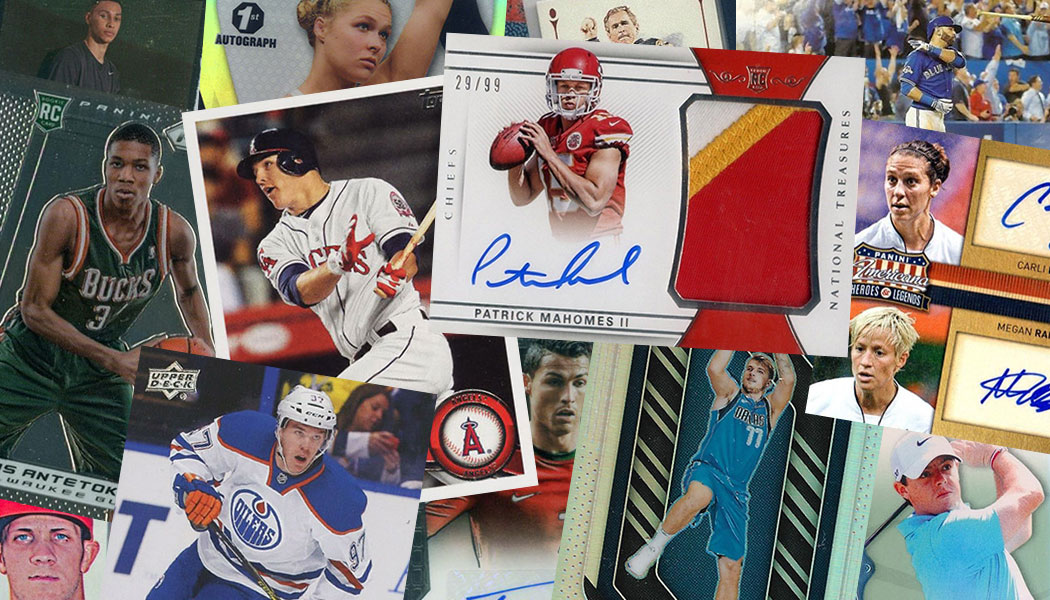
So what did cards really do? During late 2019, Lebron James Rookie Card in a perfect Gem Mint 10 condition was $1,100 fast forward to early 2021 it reached $42,000. Not only did it happen to expensive cards, it also happened to low end cards such as a Luka Doncic Rookie Card in a Gem Mint 10, buying it for $50 in early 2020 and selling it for $2,000 such as I did back in 2021. It happened to football cards also where a Patrick Mahomes Rookie Card in a PSA 10 selling for $14,000 off a $200 investment in 2020, and baseball cards, hockey cards and even Pokemon cards. All sales provided by Card Ladder. Sports cards blew up in a way no one could have imagined.
I wouldn’t be writing this if I had not experienced this boom. I’ve always been a collector all my life but in 2019 I decided to get serious about it and started trying to make some money off of it. I was buying cards on eBay, getting them graded to try and add more value to the card and selling them in 2020 for a lot of money. It really opened my eyes to see the potential when I bought a Zion Williamson rookie card for $20, got it graded and sold it for $1000. My biggest sale I had was for $10,000 for a Collin Sexton card. I had paid $400 for it. I had built a collection worth more than 6 figures at the time. Then as fast as the market went up, it went down just as fast.
Fast forward 3 years and the sports card market went from boom to bust, cards have now dropped approximately 90% since their peak. The $42,000 Lebron James card I talked about above is now worth $4,000. The Luka Doncic card is now worth $250 and the Mahomes rookie card is worth just over $4,000. In 5+ short years the sports card market went from making people rich to now a lot of them losing money on their investments. What once was a raging market in 2020 and 2021 has cooled to pre covid levels in 2025. Will we ever see a bubble this big again?
On this episode of Student Athlete Talk, I spoke with VC Softball Catcher Jennie Jacinto and VC Women’s Soccer Midfielder Jillian Smith on what life is like as a Student Athlete. They go into depth of the trials and tribulations of dedicating the majority of their life to their sport. From making the best of friends, to the sacrifices their families have made for them to continue their sports careers. We discuss why they chose to continue their sports to the collegiate level and what their lives look like doing so.










 VC Social