
BookTok is an incurable disease.
BookTok is just women who are functionally illiterate.
BookTok [pisses me off] so bad, it’s all like all dumb [people] gathered at the same place.
All I’m really saying is that all of the women on “BookTok” need to be banned from continuing to “read.”
Whether you agree with these comments or not, there is a conversation in them that must be had.
I want to begin this conversation by addressing that I will be using only male and female genders, along with stereotypical gendered behaviors, to discuss a broader societal concern. However, that does not wholly remove other genders from this conversation. Furthermore, this is not a hate piece about men. It’s more so a call to action; a hope that they aren’t left behind.
Are you familiar with “male flight?” It’s possible that you don’t know the phrase, but you’ve watched it happen. Simply put, male flight refers to the phenomenon where, as an activity, occupation, or product is increasingly associated with women, men leave. It is often coupled with the fear of being seen as unmasculine and is likely an unconscious action. During male flight not all men leave, of course, but it is a big enough shift for it to be named.
Now that you’re familiar with the term, what does all of this have to do with BookTok hate comments? I am so glad you asked! I would love to give you a short and sweet history lesson.
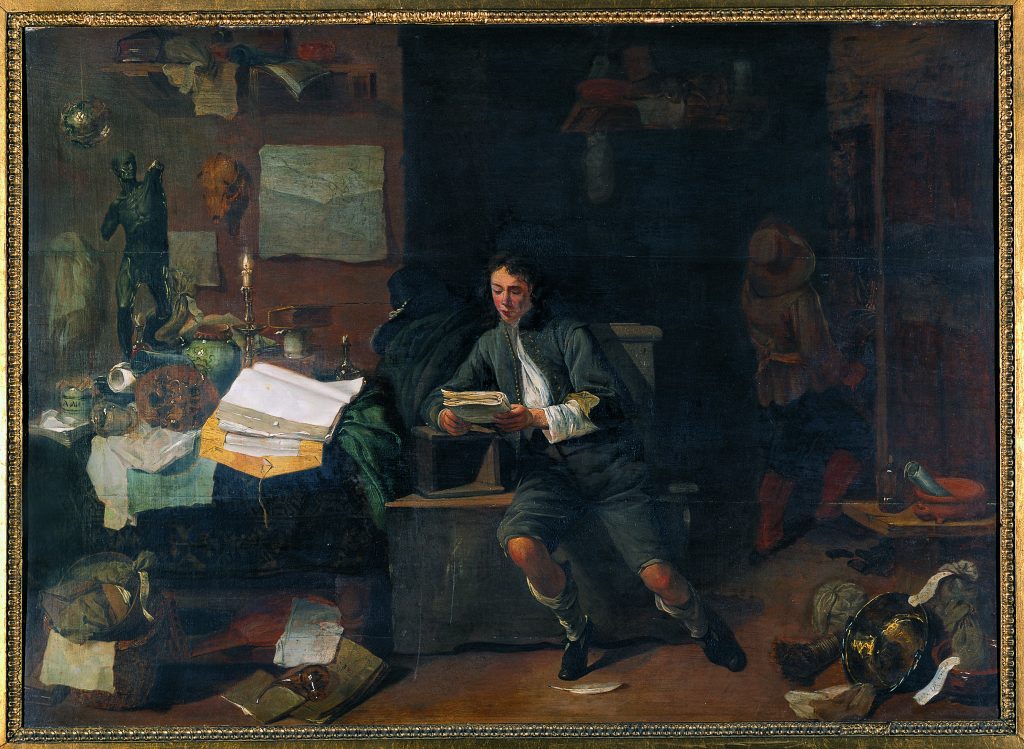
Young Man Reading by Jacob van Loo
In the days of Christian Europe, reading and accessing books was not for just anyone; it was for wealthy men. It wasn’t until modern times that learning to read and having access to books became more widely available. Still, women’s reading habits were monitored and restricted. It wasn’t until “the turn of the twentieth century, women’s access to higher learning and the appearance of mass culture, for mentalities to evolve. Today, the relation to books has been completely reversed, as the world of books is generally considered as feminine” (Matamoros).
Now, in the United States, at least, women are free to consume the content they wish to. With the rise of social media, women can connect with other women, form communities, and share ideas. It all feels positive until you remember the comments from the beginning.
The more women find interest in reading, the more it is seen as a feminine hobby rather than a masculine one. Thus, the more you will see male flight. There are many issues with males refusing to read; one being that they are missing out on vital information that can help them understand the world, their peers, their partners, their families, and themselves. Studies already show that men struggle to consume content from perspectives unlike their own. Women’s Prize released an article sharing, “research confirms that while women read books by women and men equally, men overwhelmingly reject books written by women in favour of male authors.” Men are actively leaving a space that is vital to their growth.
The fear of male flight is not unwarranted. When men flee a space, its value is lessened. Though I wish that were not the case, the more women are centered in the writing world, the more literature, books, and the career of writing will be devalued. This could lead to less funding, less pay, less attention, and even less education. Men fleeing the hobby of reading is damaging enough, but then those actively hating on women who enjoy reading makes male flight truly harmful to everyone involved.
The discourse and hate around women’s reading habits, especially online, seem to form around romance novels. While many women enjoy romance novels, it’s not the only genre they engage with. And, despite what many may think, fiction and non-fiction hold equal importance. Though fiction can be more flowery and feel frivolous or shallow, it often takes important concepts and makes them more digestible and entertaining. One can learn just as much from a self-help book as one can from a hero’s journey fiction novel. The assumption that romance has no value should be concerning to all. And while there is a very real conversation to be had about the types of romance that exist and the age levels that people are consuming those novels, it doesn’t then mean all romance is bad and trivial.

Penguin Random House Booker Prize-Winning Books
As a woman in the book industry, I fear what will happen to literacy rates and the world of reading if men deem it worthless. I started my career in books at Ventura College, learning the foundations of literature with Professor John Guelcher. I sat down with him to discuss this issue of male flight, asking him his thoughts and solutions to this very real issue.
I opened the conversation by asking if he had seen a shift in the number of men versus the number of women in his classes. He noted that his classes have always leaned female, now with rates as high as 75-80% female. When I asked why he believes that to be the case, he brought up that in the past thirty years, the way higher education is structured has shifted to a more stereotypically feminine way of teaching. There is less of a focus on competition and more of a focus on group work and connection. Without the competition as a motivator, Guelcher thinks men are struggling.
Guelcher: Males have a harder time succeeding in the academic institution as they are constructed now. I think that’s what’s happening in the classroom.
Guelcher then continued to bring up other influences on male flight.
Guelcher: As it pertains to the specific discipline of English, I think that you also have this privileging of STEM. It’s this default thing you should do. If I ask my students what their major is, no one ever says the Humanities. They say, “Oh, Business.” “Why are you a business major?” “I just wanna make money.”
This comment sparked my interest because all I have seen in recent years is a push for more women in STEM. Even with the encouragement, though, “America needs still more diversity in STEM fields…Currently, women represent just 10% to 25% of the semiconductor industry, and historically underrepresented groups make up only 20%” (Women in STEM). So, while women are entering STEM, it is still seen as a worthwhile pursuit for men, and the humanities are falling to the wayside. I don’t say this to devalue or discourage STEM involvement, I merely say it to say that both are valuable and necessary, and we can’t leave either behind because women want to be a part.
Whittington: Unfortunately, if men are not actively engaging in literature and aren’t interested in it, it will not be seen as a worthy pursuit or usage of time. Which then eventually shifts to women who are authors being paid less because it’s not as important. When it is a male-dominated field, then it is important, and it is worth paying a lot of money for. And as we see this shift to it being very female-centered, there is a worry about how female authors are going to survive. There is that kind of slight fear of, “what happens to us?”
Guelcher: I think there are two levels. There’s the existential level of literature being valuable, why literature is valuable. And the problem of males not accessing this beautiful thing, this important thing, that is what makes us really understand the world we live in. Those of us who appreciate literature know how valuable it is to read a book and if there’s a major portion of the population who don’t understand that, that’s a loss. That’s a huge loss, existentially. On the capitalistic side of things, the amount of money that people are making for their chosen pursuit, yeah, absolutely, it makes complete sense that if males aren’t doing it, our society doesn’t value it. That is the reality. If males are into it, commerce will go and back it up and help prop it up. But if it’s only females, we dismiss it. That’s a real problem.
Whittington: Do you think that there’s any way to re-engage, specifically young men, in literature?
Guelcher: I mean, that’s a million-dollar question right there, but I think it’s convincing people it’s a worthwhile pursuit. I have a master’s in literature. My PhD is in composition, but I went pretty high up in literature, and so I value it, obviously. But like my brother, who’s a smart guy, for a long time, he proudly would say, “I’ve never read a book. I’ve only read textbooks. I’ve never read a book.” And he would hang his hat on that, and I’m like, just read a freaking book. This is a great book. You should read it. You’d love it. He’s like, “No, I don’t read,” and he’s smart. I know a lot of guys like that, and I think part of it is figuring out a way to get them to see it as a valuable pursuit. How to do that is a good question. I think, you know, you look at what males who don’t read like. Podcasts are big. Like if somebody like Joe Rogan goes on and says, “Hey, man, you gotta read this Barbara Kingsolver book. This is freaking great.” And I think shorter fiction might be a way to do it, because our attention spans seem better for that.
He continued, sharing a story from his visit to Canada.
Guelcher: In Canada, they were all talking about books the way we talk about TV shows. And I was like, “Whoa, what is this place doing?” Everybody was talking about books, like we talked about TV, and that really struck me. And then they were talking about similar books. And so I think maybe, you get somebody who males trust, who convinces them that this is a worthwhile pursuit, and then kind of all talk about it, be able to share ideas. What makes literature classes good? It’s everybody talking about the same book. And that seems to be one of the problems with our information age, it’s so rare that we have a common book we’re reading.
He’s right. The reason that BookTok and Bookstagram are so popular is that they provide a space for women to read books together as a community. If men began to authentically engage in these spaces, it might remove the stigma and broaden their horizons.
Guelcher: An important thing, too, I think, is to maybe embrace the audiobook as well. I think there’s a study done recently that showed that listening to an audiobook and reading a book are generally doing the same thing. So yeah, to demystify that and not make it feel like it’s a bad thing might help people feel like, “Oh, I’m not weak for listening to an audiobook. I’m not a failure.” I think if more people listened to audiobooks, they’d understand more of like, “Oh, a deep and engaging story is valuable,” you know?
Whittington: I think you just have to destigmatize that audiobook listening is not actually processing a book, because that’s been a big conversation online. You can’t say you’ve read a book or you’ve consumed a book if you listened to it; no, you have! If you’re actively listening, you have.
Guelcher: Is it the exact same? No, but yeah, pretty darn close. It’s closer than you know.
Guelcher and I concluded our conversation still with the knowledge that male flight very much does exist, and this may occur in the world of literature. Let’s be honest, we were never going to solve this issue in an article or an interview, but we can bring awareness to it. Maybe gift a book this year. Maybe pick up a book yourself or talk about a book with a friend. If you’re really ambitious, take an English class at a local college (if you’re in the Ventura College area I highly recommend a glass with Guelcher). Also, be aware of how you and others are speaking about women’s hobbies, like reading. Are you or them being unnecessarily disparaging, or are there valid critiques? Are you giving the hobby a gender or leaving it open for all to enjoy?
It might sound silly, but the Humanities are vital to the progression of humanity. We can’t let something as important as reading and literature disappear just because women love it. And the more we have this conversation, the more awareness is brought, and hopefully, the more solutions are created.
If you’re interested in learning more about male flight, Medium has a good article on the topic. And if you are a visual/auditory learner, The Book Leo has a great video essay on this male flight; she is actually the reason I wanted to do this research myself. If you’ve made it this far, I hope you learned something new. If you didn’t, I hope you at least enjoyed it.
And with that, though it’s been a heavy one, I’ve been me, and this has been lovely.

 VC Social